
Inspecting cut edges, valleys, and eaves where edge corrosion starts
Looking underneath where access allows, because backside condensation corrosion shows there first Identifying any dissimilar-metal contact driving galvanic attack
fastener and seam corrosion, panel rust-through, galvanic damage, and restoration coatings built for Gulf air.
Galvanized and Galvalume coatings protect the steel, but every cut made during the original install exposes raw edge.
Schedule a roof reviewEave ends, valley cuts, and field-trimmed panels all start corroding from the exposed edge inward. On older roofs you can often see the rust line creeping back from every cut.
When dissimilar metals touch in the presence of moisture, one corrodes to protect the other. Copper flashing or condensate lines draining across a steel roof, the wrong fasteners in an aluminum panel, or a careless repair with mismatched metal will set up galvanic cells that eat the more active metal fast. We find this often where a past repair used whatever screws were on the truck.
Any spot on a metal roof that holds water or traps wet leaves and grit corrodes faster than the rest. Low-slope metal that ponds after a Houston downpour, and the uphill side of curbs and equipment where debris piles up, are reliable corrosion hotspots.
Surface rust and structural rust-through are two completely different problems, and the repair plan depends entirely on telling them apart. We get on the roof and inspect it closely rather than judging from the ground or a photo.
Probing rust spots to see whether the steel is still sound or has thinned and perforated
Roof planning notes
Looking underneath where access allows, because backside condensation corrosion shows there first Identifying any dissimilar-metal contact driving galvanic attack
The key question is whether the panels still have structural integrity. A roof with surface rust and corroded fasteners but sound steel is a strong candidate for restoration. A roof with rust-through perforations and thinned panels needs metal replaced before anything else, because no coating bridges a hole in the deck. Talk with a Houston commercial roofing team
A standing-seam or R-panel metal roof can outlast almost any other commercial system, but only as long as the protective coating and the galvanizing hold. Once corrosion starts on a Houston building, the Gulf Coast environment pushes it hard. Salt-laden air off Galveston Bay, year-round humidity, and roofs that stay wet through long, heavy rain events all feed the electrochemical reaction that turns steel to rust. We see corrosion across the full range of metal stock here, from warehouse and distribution roofs along the Ship Channel to retrofit metal over older retail and office buildings.
The trouble with metal corrosion is that it almost always starts where you cannot easily see it: under fasteners, inside seams, on cut panel edges, and on the back side of panels where condensation collects. By the time rust streaks are obvious from the parking lot, the damage underneath is usually well advanced.
Exposed-fastener metal roofs are held down by thousands of screws, each one a small puncture through the panel's protective coating. The neoprene washers under those screws harden and crack under Houston UV, the screws back out as the panels expand and contract, and water gets into the hole. Once moisture reaches the bare steel inside a fastener hole, rust spreads outward from every screw at once. A roof can look fine between the fasteners while quietly rusting at every penetration.
Where panels lap, capillary action pulls rainwater up between the metal layers and holds it there. That trapped moisture has nowhere to dry in our humidity, so the inside faces of the lap corrode even while the exposed surfaces look clean. Side laps and end laps on low-slope metal are especially prone because water drains slowly and lingers in the joint.
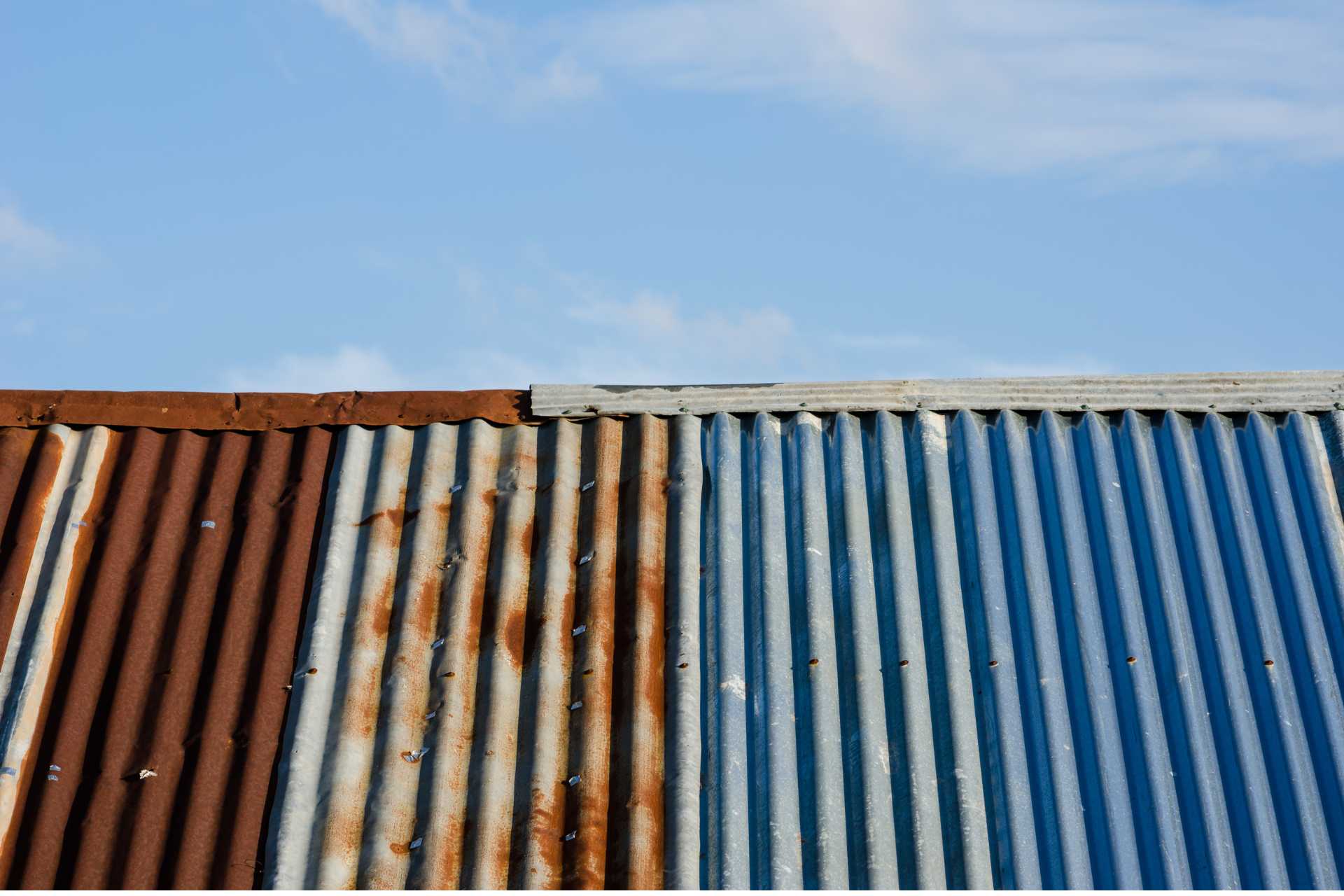
Galvanized and Galvalume coatings protect the steel, but every cut made during the original install exposes raw edge. Eave ends, valley cuts, and field-trimmed panels all start corroding from the exposed edge inward. On older roofs you can often see the rust line creeping back from every cut.
When dissimilar metals touch in the presence of moisture, one corrodes to protect the other. Copper flashing or condensate lines draining across a steel roof, the wrong fasteners in an aluminum panel, or a careless repair with mismatched metal will set up galvanic cells that eat the more active metal fast. We find this often where a past repair used whatever screws were on the truck.
Any spot on a metal roof that holds water or traps wet leaves and grit corrodes faster than the rest. Low-slope metal that ponds after a Houston downpour, and the uphill side of curbs and equipment where debris piles up, are reliable corrosion hotspots.
Surface rust and structural rust-through are two completely different problems, and the repair plan depends entirely on telling them apart. We get on the roof and inspect it closely rather than judging from the ground or a photo.
The key question is whether the panels still have structural integrity. A roof with surface rust and corroded fasteners but sound steel is a strong candidate for restoration. A roof with rust-through perforations and thinned panels needs metal replaced before anything else, because no coating bridges a hole in the deck.
Corroded and backed-out screws come out and get replaced with larger-diameter fasteners that bite into fresh metal, fitted with fresh sealing washers. Upsizing is what lets a new screw hold in a hole the old one stripped. On exposed-fastener roofs this alone resolves a large share of active leaks.
Corroded seams get cleaned and sealed; on roofs worth restoring we treat the seams and laps with reinforced sealant or a flashing-grade material before any coating goes down, so the joint is waterproofed rather than just painted over. Cut edges and valleys that are corroding get the same attention because a coating over an untreated rusty edge fails from that edge.
Sound steel with surface rust gets the corrosion removed, then a rust-inhibitive primer that bonds to and neutralizes the remaining surface oxidation. This step is what keeps rust from continuing under whatever goes on top. We do not coat over loose or active rust and call it done.
Where panels are perforated or thinned past saving, we replace the affected sections with matching profile and gauge, set on sound substrate, and tie them back into the surrounding roof. Replacing rusted-through metal is non-negotiable; a roof with holes is not a coating candidate until those panels are addressed.
For a structurally sound metal roof, a restoration coating is usually the most cost-effective path. After fastener, seam, and rust treatment, we apply a coating system that seals the entire roof into a continuous waterproof membrane and stops the corrosion clock. A reflective coating also drops the roof's surface temperature, which matters under relentless Houston summer sun and cuts the thermal cycling that loosens fasteners in the first place. Restoration avoids tear-off, keeps the building dry through the work, and extends a metal roof's life by years.
Treating rust without addressing why it started just buys time. Wherever we find galvanic corrosion, we isolate or remove the dissimilar-metal contact so the cell stops. Where ponding feeds the corrosion, we look at improving drainage so water moves off instead of sitting. Where backside condensation is the driver, ventilation and the coating's thermal effect both help. The goal is a roof that is dry, sealed, and not actively eating itself.
We give a straight answer on which path a roof needs. Surface corrosion, failed fasteners, and leaky seams on sound steel point to restoration. Widespread rust-through, structural thinning, and panels that crumble at the probe point to section or full replacement. For a building owner along the Ship Channel or out near the Energy Corridor, the difference is large money, and the call should be based on what the steel is actually doing, not on what is easiest to sell.