
What the Scan Tells You
The point of the survey is to convert a vague leak problem into specific, bounded decisions. Where the water actually is. The wet areas, not the interior stains, define what needs work.
We locate trapped water in flat and low-slope assemblies so you repair only the wet areas, not the whole roof.
An accurate scan depends on conditions and method, not just the camera.
Schedule a roof reviewTiming the Survey
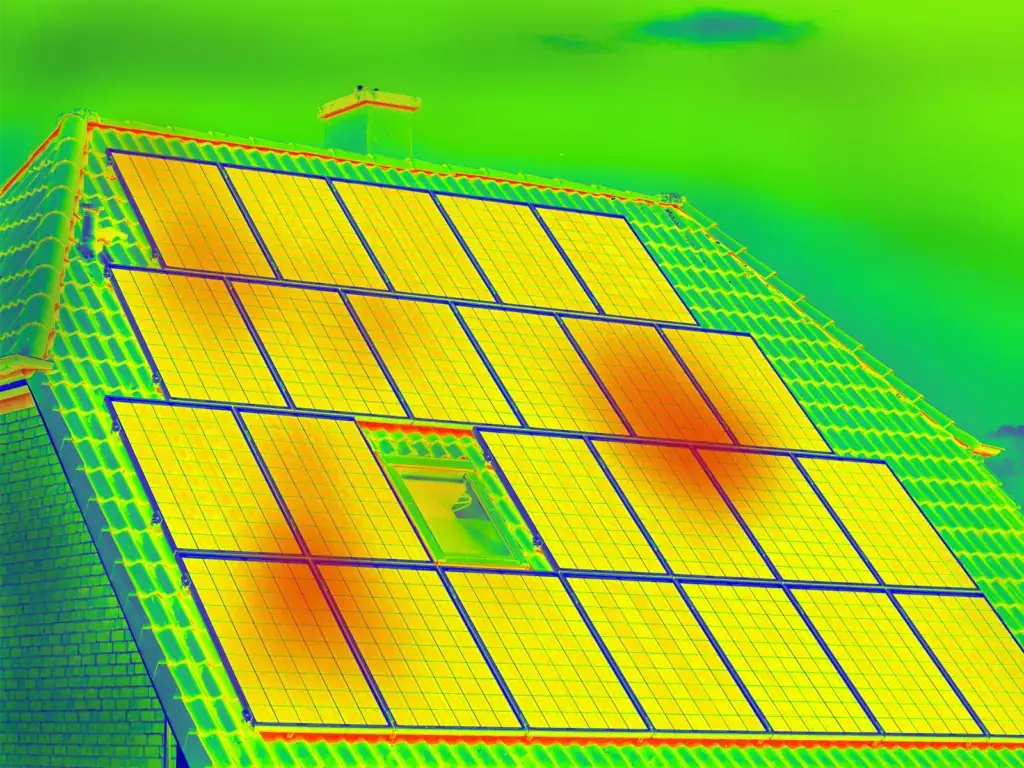

The temperature contrast that makes wet areas visible builds after a warm, clear day and emerges as the roof cools, so we typically scan in the evening after good solar loading. We also want the surface dry, which on the Gulf Coast means working around the rain and the humidity that can mask readings. Getting the window right is the difference between a clear map and an ambiguous one.
We survey the full roof area with the infrared camera, capturing the thermal patterns and correlating them against what we see underfoot, including ponding marks, blisters, open seams, and failed flashings. Walking it also catches the physical defects a camera alone would miss.
Thermal anomalies can have other causes, so where it matters we verify suspected wet areas with direct moisture readings or test cuts before anything is called saturated. We would rather confirm a wet zone than have you pay to replace insulation that turned out to be dry.
Mapping the Results
Roof planning notes
The point of the survey is to convert a vague leak problem into specific, bounded decisions. Where the water actually is. The wet areas, not the interior stains, define what needs work.
How much of the roof is affected. A few isolated wet zones point toward targeted repair; saturation across a large share of the roof points toward replacement. The scan tells you which situation you are in before you commit capital. Talk with a Houston commercial roofing team
Water that gets past a flat roof's membrane rarely shows up where it entered. It travels through the insulation, spreads sideways, and surfaces as a stain in a ceiling tile far from the actual breach. Infrared moisture scanning finds the wet insulation directly, mapping the saturated areas across the whole roof so repairs target the real problem instead of chasing drips. We run these scans on commercial and industrial roofs throughout Greater Houston and Harris County.
The method works because wet insulation holds heat differently than dry insulation. After a sunny day, a roof absorbs solar energy, and as it cools in the evening the saturated areas release that stored heat more slowly than the dry field around them. An infrared camera reads those temperature differences and renders them as visible patterns, letting us trace the footprint of trapped moisture. On Houston's enormous inventory of low-slope warehouse, distribution, and office roofs, that footprint is often far larger than anyone expected from the interior leaks alone.
The Gulf Coast pushes a lot of water at commercial roofs, and several local conditions make moisture intrusion common here.
An accurate scan depends on conditions and method, not just the camera. We plan the survey around the physics so the results are reliable.
The temperature contrast that makes wet areas visible builds after a warm, clear day and emerges as the roof cools, so we typically scan in the evening after good solar loading. We also want the surface dry, which on the Gulf Coast means working around the rain and the humidity that can mask readings. Getting the window right is the difference between a clear map and an ambiguous one.
We survey the full roof area with the infrared camera, capturing the thermal patterns and correlating them against what we see underfoot, including ponding marks, blisters, open seams, and failed flashings. Walking it also catches the physical defects a camera alone would miss.
Thermal anomalies can have other causes, so where it matters we verify suspected wet areas with direct moisture readings or test cuts before anything is called saturated. We would rather confirm a wet zone than have you pay to replace insulation that turned out to be dry.
We mark the wet areas on a roof plan so the saturated zones are located and sized. That map is what turns a scan into a repair scope and a budget number.
The point of the survey is to convert a vague leak problem into specific, bounded decisions.
Infrared scanning is worth running in several common situations across the Houston market.
Following a hurricane, a hail event, or a heavy rain band, a scan reveals whether water got into the assembly even if the interior looks dry, so you can document and address damage before it spreads.
For a building you are acquiring or a roof you are considering coating, a scan establishes the true condition of the insulation, which is exactly what is hidden under the membrane and easy to misjudge from the surface.
When a roof keeps leaking and patch after patch has not stopped it, the trouble is usually a wet area feeding multiple interior symptoms. The scan locates the source so the repair finally holds.
The advantage of scanning is precision. On a large Houston warehouse or distribution roof, replacing only the saturated sections and reflashing the failed details can cost a fraction of a full tear-off while restoring a watertight roof. We use the scan map to scope that work, and where the saturation is too widespread for repair to make sense, the same map supports the case for replacement with the wet extent clearly documented. Either way, you spend on the part of the roof that is actually wet.