


Skip to content

High Wind Damage Roofing in Houston, TX

Schedule a Roof Review

  • High Wind Damage Roofing for Houston Commercial Buildings
  • Every June through November, the Gulf of Mexico sends a season's worth of pressure against the flat and low-slope roofs that cover most of the commercial building stock across Harris County. Hurricane Harvey is remembered for its flooding, but the wind events that move through this region year after year do quieter, more expensive damage to roofs: peeled membrane edges, lifted metal coping, and fasteners that have started to back out of the deck. We repair and restore commercial roofs that have taken high-wind damage, and we do the forensic work first so the fix actually addresses how the failure started.
  • Wind almost never destroys a commercial roof from the top down. It works the perimeter and the corners, where uplift pressures are highest, then exploits whatever was already loose. A single lifted edge flashing on a warehouse off the Sam Houston Tollway can let the next gust get underneath an entire membrane field. Understanding that sequence is the difference between a patch that holds and a patch that fails in the next storm.
  • How Wind Damages a Low-Slope Roof Here
  • The roofs we inspect after a storm tend to show damage in a recognizable pattern, and knowing where to look saves owners from paying for problems they don't have while missing the ones they do.
  • Perimeter and corner uplift: Building codes treat roof corners as the highest-pressure zones for a reason. This is where we most often find membrane separation, billowing, and detached edge metal after a wind event.
  • Failed edge metal and coping: Loose or undersized gravel stop, fascia, and coping caps are the most common entry point. Once the edge goes, wind gets under the field and the damage accelerates fast.
  • Fastener pull-out: On mechanically attached single-ply systems, repeated wind cycling backs fasteners out of the deck. The membrane looks intact but is no longer anchored.
  • Punctures from flying debris: In a dense district like Westchase or the Galleria area, wind-driven debris and dislodged rooftop equipment panels puncture membranes and crack the surface of older built-up roofs.

Roof planning guidance

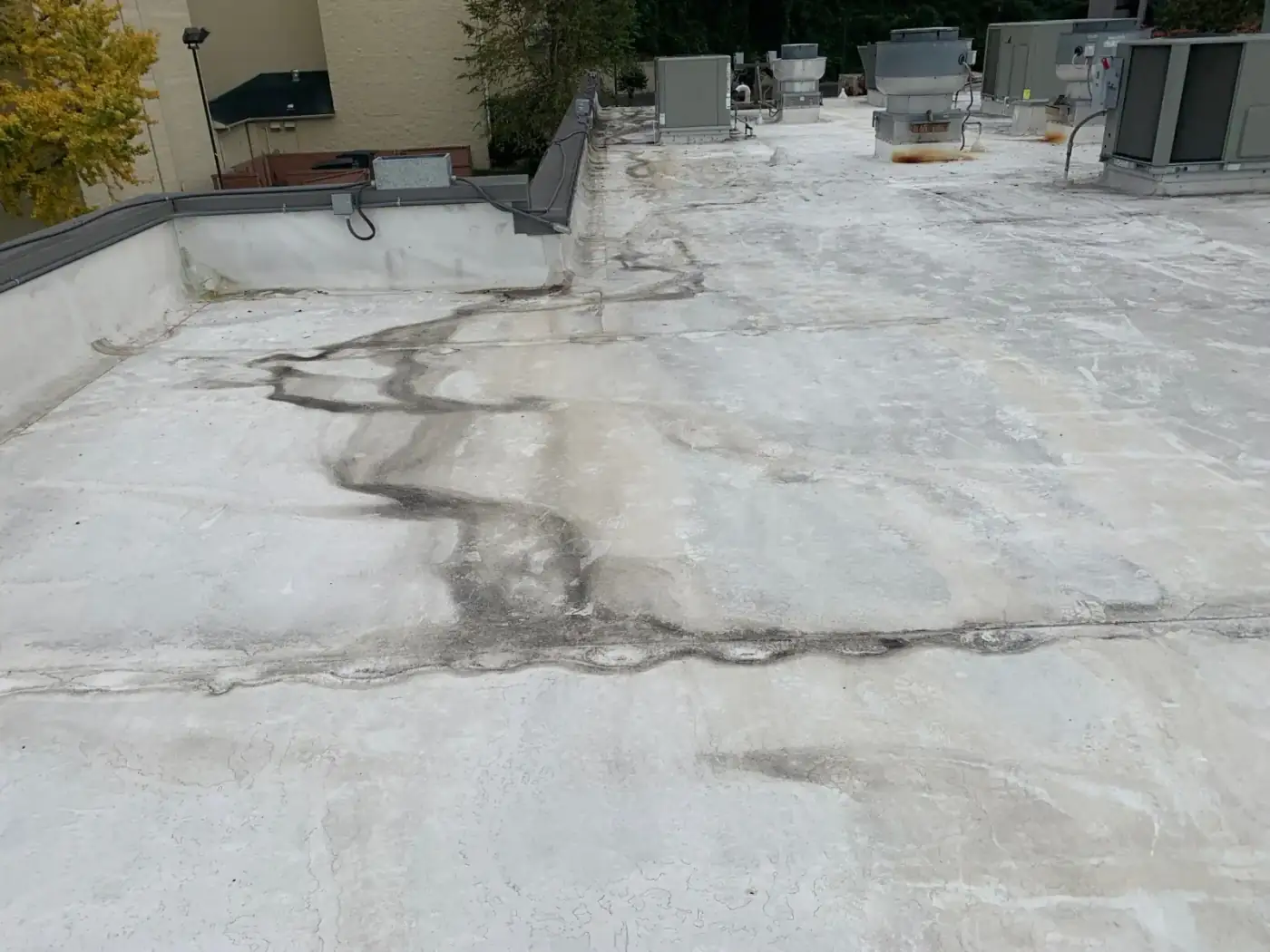
Seam and lap separation: Aged adhesive at seams gives way under flutter, opening long linear paths for water that aren't obvious from the ground. Our Wind Damage Assessment We start with a full walk of the roof, not a drive-by. Because Gulf Coast wind damage is so often hidden under intact-looking membrane, we probe seams and terminations, check fastener pull resistance, and pull back questionable edge metal to see what the wind actually disturbed underneath. We document everything with photographs and measurements, because that record matters whether you are filing an insurance claim or simply budgeting the repair.

Schedule a roof review
High Wind Damage Roofing in Houston, TX
Downtown Houston commercial rooftops

Moisture intrusion is the other half of the assessment. Once a membrane has been compromised, water tracks laterally through the insulation and shows up as interior staining a long way from the actual breach. We use moisture survey methods to map wet insulation so we replace what is saturated rather than sealing water inside the assembly, where it will rot the deck and feed mold in our humidity.

Repair and Restoration Methods

What we recommend depends on the system you have and how far the damage spread. Sometimes the right answer is a targeted, durable repair. Sometimes a roof has reached the point where re-securing it costs more than it's worth and a recover or replacement makes more sense. We tell you which, and we explain why.

Houston Energy Corridor commercial buildings

Edge and termination rebuilds: We re-anchor or replace edge metal, coping, and flashings to current wind-uplift detailing so the most vulnerable part of the roof is the strongest part of the repair.

Membrane repair and re-securement: For single-ply systems, we re-fasten loose field areas, re-weld or re-adhere open seams, and patch punctures with manufacturer-compatible materials so the repair carries the same warranty logic as the original.

Wet insulation replacement: Saturated boards come out and dry, code-compliant insulation goes back in, restoring both the R-value and the substrate the membrane depends on.

Roof planning notes

Roof Scope Notes

Talk with a Houston commercial roofing team

Drainage Cannot Be an Afterthought

Wind and water arrive together on the Gulf Coast, so a wind repair that ignores drainage is only half a repair. Harris County's heavy rain events overwhelm roofs where wind has crushed insulation flat or knocked debris into drains and scuppers. As part of any wind repair we clear and check drainage paths, confirm positive slope to drains, and look for ponding that adds dead load and shortens membrane life. Standing water on a roof that just survived a storm is a roof that will fail in the next one. Working Around Your Operations

After the Storm, Before the Next One

The buildings we work on are rarely empty. A distribution center near the Port of Houston runs around the clock, a hotel near the Texas Medical Center has guests who don't want jackhammering at dawn, and a tenant-occupied office in the Energy Corridor has people underneath the work. We sequence wind repairs to keep your building watertight at the end of every shift and to keep noise, fumes, and access disruption out of your way as much as the job allows. We also keep an eye on the forecast, because committing to an open repair the day before a system moves in is how a manageable problem becomes a flooded interior. Talk with a Houston commercial roofing team