Skip to content

We install Johns Manville TPO, PVC, EPDM, modified bitumen, and JM polyiso on Houston commercial roofs. Single-source systems for Gulf Coast heat and storms.

Schedule a Roof Review

  • Johns Manville systems we install in Houston
  • We install Johns Manville roofing systems on commercial and industrial buildings throughout Greater Houston. What sets JM apart among roofing manufacturers is the breadth of the line under one roof: thermoplastic single-ply in TPO and PVC, EPDM rubber, SBS and APP modified bitumen, built-up systems, and — unusually for a roofing brand — JM's own polyiso insulation and cover boards manufactured in-house. That means a JM roof can be specified as a single-source assembly, membrane and insulation and accessories from one manufacturer, which simplifies the warranty path and removes the finger-pointing that can happen when components come from different makers.
  • Breadth only matters if the right system gets matched to the right roof. We use JM's range to fit the building in front of us — a reflective membrane where cooling load leads, a chemical-resistant sheet where rooftop exhaust is a factor, a layered asphalt system where redundancy leads — rather than installing one product on every job. The choice follows the roof, the exposure, and how the building is used.
  • TPO and PVC: reflective single-ply for Houston heat
  • JM's thermoplastic membranes are white single-ply sheets, and on a large flat footprint that reflectivity is a real advantage. The roof is the dominant heat-gain surface on a single-story building, and a white sheet returns the bulk of incoming solar radiation instead of absorbing it, keeping the assembly cooler through a Houston August and easing the cooling load. A dark or aged roof can run well above air temperature on a clear afternoon, which both raises utility cost and ages the membrane faster.
  • TPO. JM TPO is a reinforced thermoplastic sheet welded with hot air into continuous, watertight seams. It is the common reflective choice on warehouse, retail, and office roofs. Membrane thickness matters here: a heavier sheet carries more weathering compound over the scrim, which is the layer that takes UV, foot traffic, and hail before the reinforcement is exposed.
  • PVC. JM PVC is also hot-air welded and adds strong resistance to grease, chemicals, and ponding. That makes it the better choice on restaurant roofs with kitchen exhaust, and on industrial buildings where rooftop discharge would degrade other membranes — a recurring condition along the Ship Channel and in Houston's manufacturing stock.
  • Welded seams and detailing
  • Both TPO and PVC seams are fused with hot air rather than taped, forming one continuous membrane. We probe the welds after they cool to confirm full fusion, because seams are where a single-ply roof leaks first when they are rushed. Drains, curbs, penetrations, and the roof edge get flashed with compatible JM accessories so the details meet the same standard as the open field.

Modified bitumen and EPDM where they fit

Not every Houston roof wants a single-ply sheet. JM's SBS and APP modified bitumen systems are multi-ply asphalt membranes that deliver layered redundancy and a tough, often granule-surfaced wearing layer — a sound choice where a leak above the space below is unacceptable, or where heavy rooftop traffic chews through thinner systems. JM EPDM, a synthetic-rubber membrane, stays flexible across a wide temperature range and tolerates movement well. We reach for these where the roof's behavior favors them and steer toward reflective single-ply where cooling load is the driver, and we explain the tradeoff plainly. JM polyiso insulation and cover board

Schedule a roof review
Johns Manville (JM) Commercial Roofing Systems Installed in Houston, TX
Downtown Houston commercial rooftops

A roof is a system, and JM's in-house insulation is part of what makes the line attractive. We install JM polyiso to the specified R-value, then a cover board to give the membrane a firm, uniform substrate and to add hail, fire, and wind performance. Because the insulation and membrane come from the same manufacturer, the assembly is designed to work together and is covered under one warranty path rather than split across vendors. Cutting the cover board to save money is a poor trade on a roof that has to survive hail and storm wind.

Tear-off, recover, and trapped moisture

Before new material goes down we determine whether the existing roof can be recovered or must come off. Years of small leaks — or a major rain event like Harvey in 2017 — can leave moisture trapped in the insulation, and recovering over wet insulation only seals the water in. We base that decision on infrared or core-sample moisture results rather than a guess, and when we tear off we inspect the structural deck for corrosion and deterioration before new insulation goes down. A membrane is only as sound as what it is fastened to.


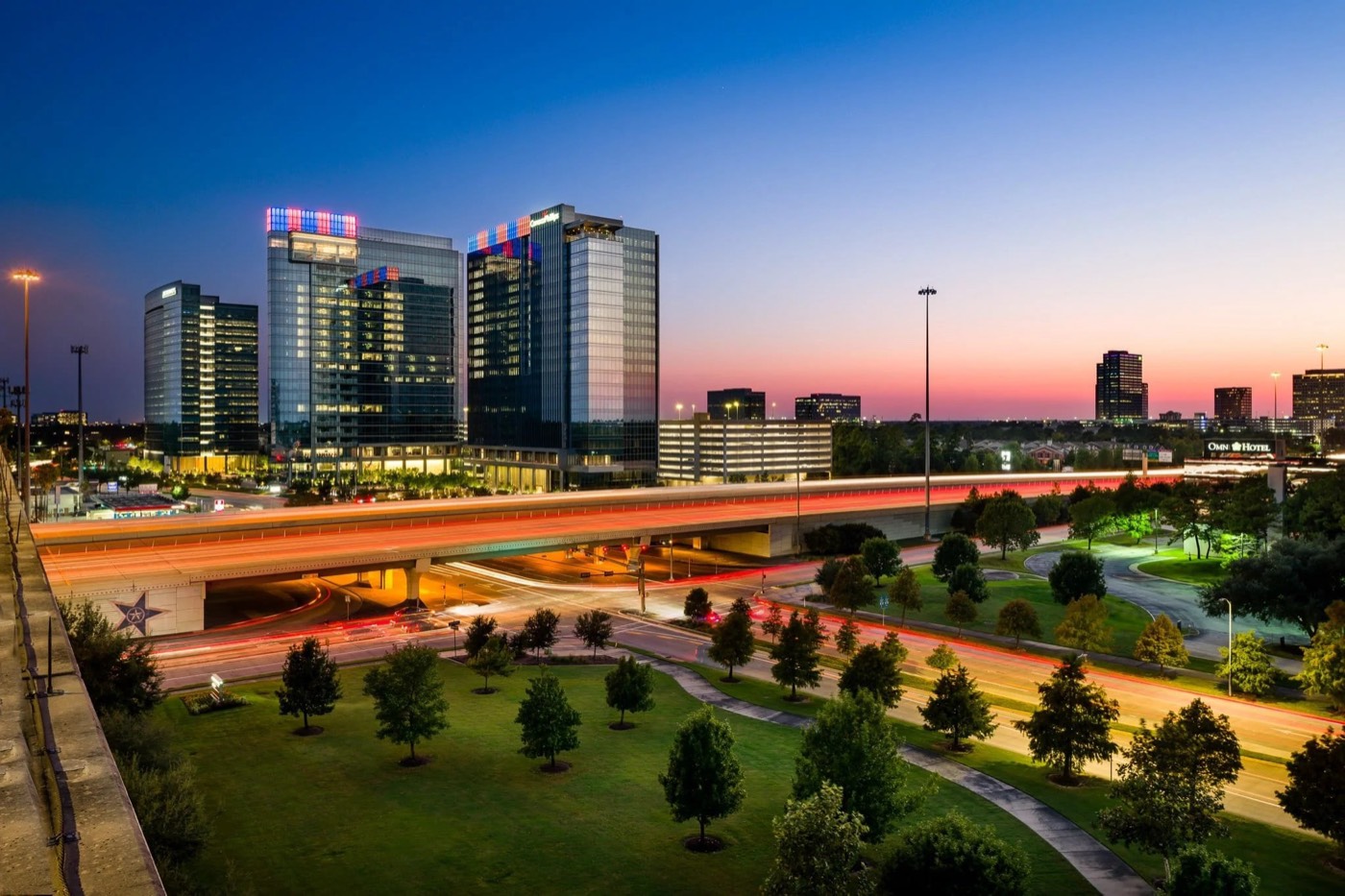
Houston Energy Corridor commercial buildings

Attachment for hurricane-season wind

Greater Houston is hurricane country, and a roof here has to resist uplift during named storms and the strong straight-line winds off Gulf squall lines. We attach JM systems — mechanically fastened, fully adhered, or a hybrid — to meet the uplift demand for the building's height, exposure, and location, with enhanced attachment at perimeter and corner zones where uplift concentrates. Storm damage on flat roofs almost always begins at an edge or corner before it reaches the field, so those zones get detailed accordingly.

Drainage detailing for Houston rainfall

Roof planning notes

Roof Scope Notes

Talk with a Houston commercial roofing team

Where Johns Manville fits in Houston

Healthcare and institutional. Buildings near the Texas Medical Center where a single-source assembly and a clean warranty path matter and interior conditions cannot be disrupted. Office and corporate. Roofs in the Energy Corridor, Westchase, and downtown where reflective single-ply cuts cooling load on large footprints.

Industrial and Ship Channel-area facilities. Buildings with rooftop chemical discharge where membrane chemistry has to match the exposure.

Restaurant and food service. Roofs with kitchen exhaust where PVC resists grease and chemical attack. Talk with a Houston commercial roofing team