

Skip to content

We re-roof occupied Houston commercial buildings without shutting you down: phased schedules, leak-tight nightly tie-ins, and tenant coordination.

Schedule a Roof Review

  • Re-roofing a building that can't close
  • Most Houston commercial buildings can't go dark for a roof. A medical office near the Texas Medical Center sees patients every weekday, a Westchase call center runs three shifts, a Galleria retail box trades through the holidays, and a refinery support building in the Ship Channel corridor never stops. The roof above all of them still ages out, takes hail damage, or fails after a tropical system. An occupied-building work plan is how we replace or restore that roof while the people underneath keep working, selling, treating, and shipping.
  • This is a different discipline from new construction or a vacant-building tear-off. The constraint is not just the roof; it is everyone and everything beneath it. The plan has to protect occupants from noise, dust, fumes, and water, keep exits and fire lanes open, and hand the building back leak-tight at the end of every shift. We build that plan before a single fastener comes out.
  • Phasing the work around how you operate
  • The core of an occupied-building plan is sequencing. We divide the roof into sections sized so that each one can be torn off and made watertight within a controlled window, and we order those sections around your operations rather than around our convenience.
  • We map the roof against the floor plan below so the noisiest tear-off and fastening happen over the areas least sensitive to it at that hour.
  • We schedule sound-heavy work around fixed events you can't move, such as clinic hours, trading-floor windows, exams, recording, or production runs.
  • We stage so that no occupied space is ever left under an open deck overnight, regardless of how the weather turns.
  • Where work has to happen above critical areas, we coordinate short relocations or off-hours windows with your facilities team well in advance.

Day, night, and weekend scheduling

Some buildings are easiest to re-roof during business hours; others need nights or weekends. A 24-hour industrial building may want disruptive work pushed to a low-staffing weekend shift, while an office tower may prefer daytime work over empty parking decks and quiet stretches. We will run daytime, after-hours, or weekend crews, and we are direct about the trade-offs of each, including how Houston heat shapes what is safe and productive on a roof in July versus an overnight shift. Keeping it watertight every single night

Schedule a roof review
Occupied-Building Roofing Work Plans for Live Facilities | Houston, TX
Downtown Houston commercial rooftops

The promise that makes occupied re-roofing possible is simple: the building never floods because of us. On the Gulf Coast that promise gets tested constantly. Houston rain does not wait for a convenient day, hurricane season runs for months, and the flat drainage that turned Harvey into a citywide flood means standing water builds fast on a roof. Harris County and HCFCD drainage realities are part of why a half-finished roof here is a serious liability, not an inconvenience.

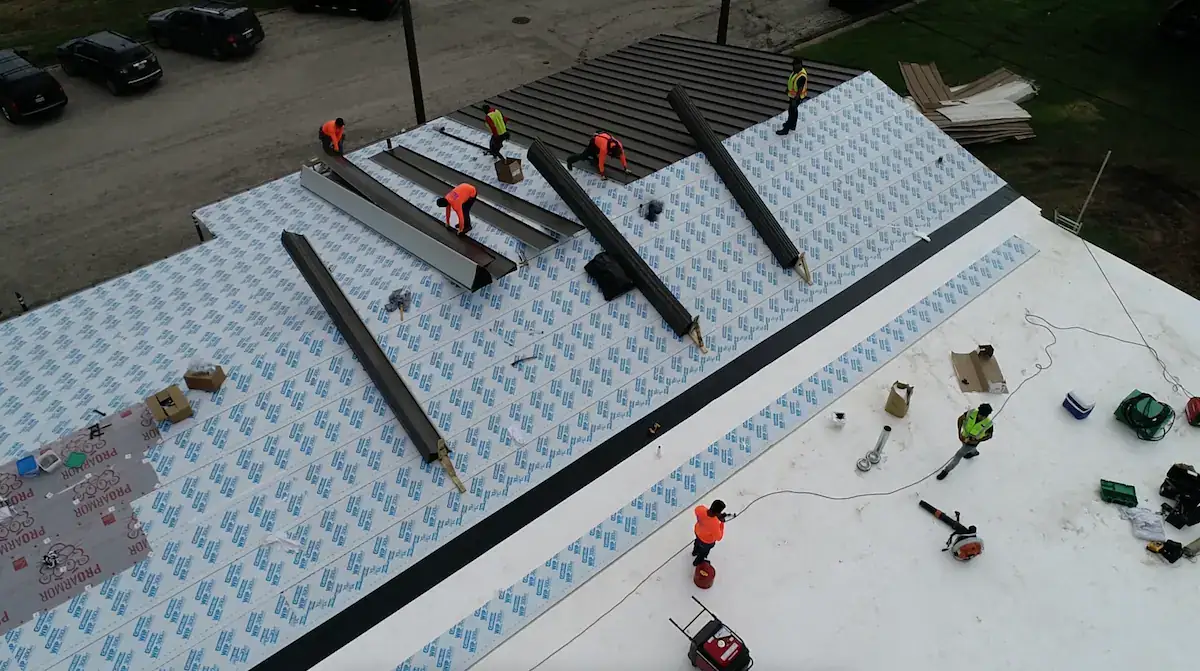
We plan every section so it reaches a watertight state before the crew leaves, and we never open more deck than we can close that day. Our daily controls include:

Tearing off only the area we can fully dry-in before the shift ends, sized down further when rain is in the forecast.

Houston Energy Corridor commercial buildings

Permanent or temporary tie-ins at every section edge so water sheds to drains instead of pooling at an open seam.

Night seals and water cut-offs at terminations, penetrations, and the leading edge of each phase.

Real-time radar monitoring during work, with pre-staged dry-in materials so the crew can close up fast if a storm builds.

Roof planning notes

Roof Scope Notes

Talk with a Houston commercial roofing team

Protecting the people and the operation below

Watertightness is one risk; the others are noise, dust, debris, fumes, and access. An occupied-building plan addresses each because the roof is only finished if the operation underneath ran cleanly the whole time. Noise and vibration. Tear-off and mechanical fastening carry into the building. We schedule the loudest phases around the most noise-sensitive spaces and hours and give building management a clear daily forecast so tenants and staff are never surprised.

Dust and debris control. We contain tear-off debris on the roof, protect drains from clogging, and keep material off the ground around entrances, sidewalks, and parking that the public and staff use.

Fumes and air intake. Adhesives, hot work, and coatings can pull into a building through rooftop HVAC intakes. We coordinate with your facilities team to manage intake louvers and damper positions, sequence odor-generating work away from active intakes, and favor low-odor methods over occupied, ventilation-sensitive spaces like clinics and labs. Talk with a Houston commercial roofing team