Commercial roofers serving Rosenberg, TX should document leak sources, wet insulation, drainage, edge details, penetrations, and repair history before recommending a scope. Schedule a Roof Review
- Roofing Brazos Town Center and the Retail That Drives Rosenberg
- Brazos Town Center is the commercial heart of Rosenberg, and big-box retail sets the tone for a lot of what we do here. The anchors, junior boxes, restaurant pads, and strip centers spread across the US- add up to an enormous amount of flat membrane roof - wide single-ply spans over steel deck, broken up by rooftop HVAC, screened mechanical wells, and long internal drain lines. These are the roofs that look perfectly fine from the parking lot for years and then fail all at once over a leased suite, because nobody is up there until water is coming through a tenant's ceiling tile. We know this building type cold, and we know that the leak is almost never the field of the membrane. It's a flashing at a curb, a split at a pipe boot, or a seam that opened after years of thermal cycling.
- For retail owners and the property managers who run these centers, a roof is an asset, not an afterthought. A leak over a national tenant's sales floor is a lease problem, not just a maintenance problem. That's why we push scheduled inspection and condition reporting on the big retail flats - so a roof gets replaced on a plan, with clean documentation, instead of in a panic after the first stain spreads across the ceiling.
- The US-59 Industrial Side and the Old Rail Town
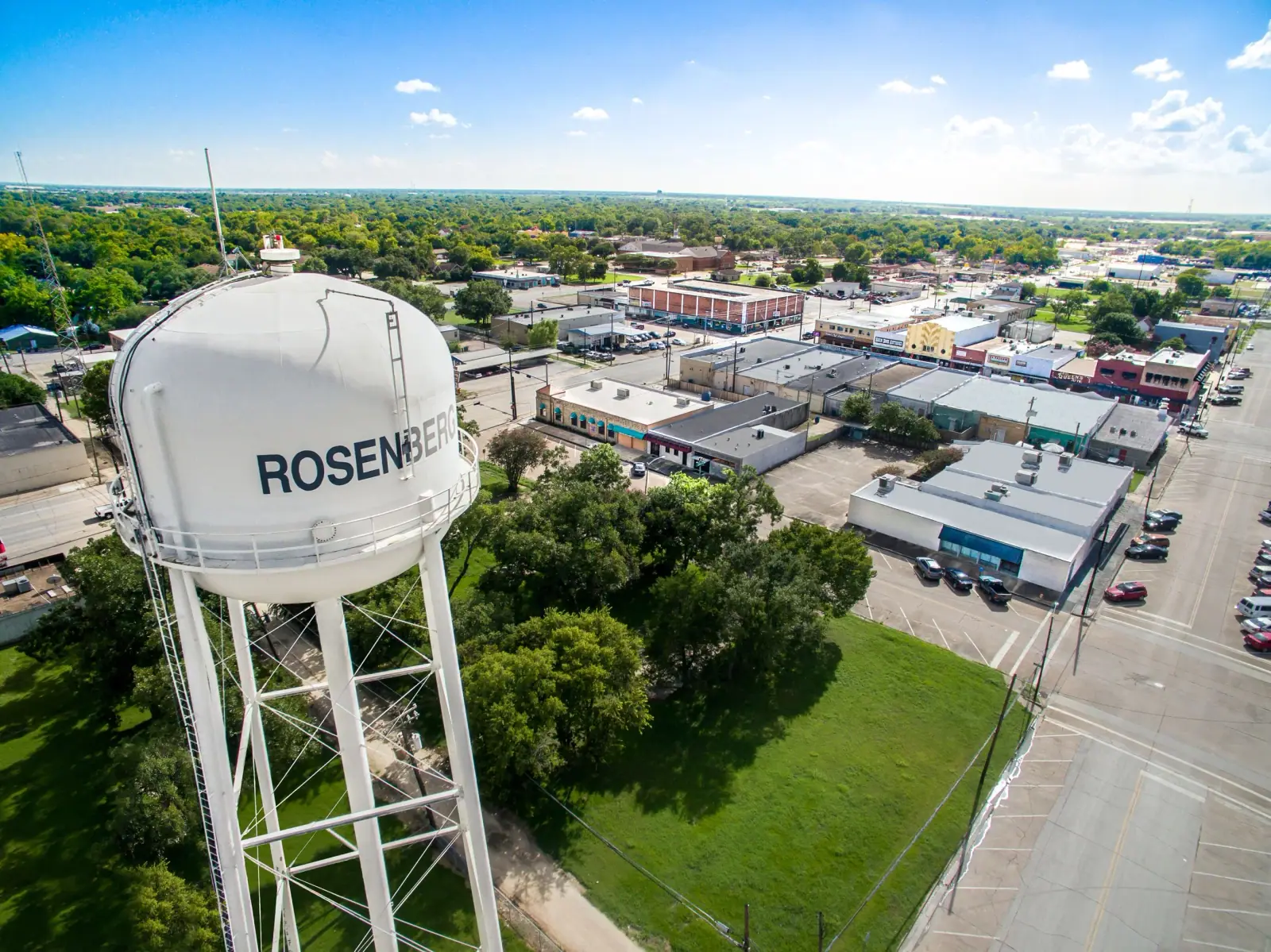
- Rosenberg grew up as a railroad town, and that history still shapes its commercial building stock. Away from the retail, the city carries warehouses, distribution buildings, contractor yards, and light-manufacturing shells along US-59 and the rail corridor, plus the older downtown around the historic depot - masonry storefronts with low-slope roofs hidden behind parapets and decades of patching layered on top. The industrial buildings are large roof areas where the deck and insulation drive the decision: if they're dry, a restoration coating often beats a full tear-off; if they're wet, no coating will save them and we'll say so. The downtown buildings are tighter, older, and frequently sharing walls and rooflines with the shop next door, where a smart phased repair usually makes more sense than a complete replacement.
- We scope the warehouse for the long clean span it is, the retail box for the tenant exposure it carries, and the depot-district storefront for the layered history under its parapet. Same trade, three different jobs.
- What the Fort Bend County Climate Does to a Flat Roof
- Rosenberg sits on the flat coastal plain in Fort Bend County, near the Brazos River, and the weather here is hard on roofs in a few specific ways. Tropical systems and hurricane bands reach this far inland with real force, and wind uplift is the failure mode we see most on low-slope roofs - pressure gets under the membrane at a corner or edge and peels it back, and the next storm finishes the job. The wide-open retail pads and corridor buildings give wind a clean run at parapets and roof edges, so we focus first on edge metal, fastening patterns, and perimeter terminations, because that's where wind-driven failure starts.
- Drainage is the other constant. Fort Bend County has its own well-documented flooding and drainage challenges, and the Gulf Coast delivers sudden, heavy downpours. A flat roof here lives or dies by how fast it sheds water - internal drains, scuppers, and tapered insulation moving water off before it ponds, adds weight, and breaks the membrane down. On the huge roof areas at a place like Brazos Town Center, a single clogged drain can pond hundreds of square feet. Every assessment we do checks that the drainage actually works, not just that the surface looks intact.
Hard spring cells move through Fort Bend most years, and hail bruises a membrane in ways invisible from the ground - fractured granules, cracked welds on aging TPO, crushed insulation under punctures that surface as slow leaks weeks later. We walk the roof after a storm and mark every impact so an owner has a dated, photographed record before it's time to file. And the long summer grinds on every flat roof, with surface temperatures far above the air, plasticizers cooking out of older membranes, and seams that held in spring opening up by August.
Choosing the Right System
There's no single right roof for Rosenberg and we don't push one. On the big retail and distribution flats, a reflective single-ply like TPO or PVC earns its keep - a white surface throws back a real share of the summer sun and eases the load on rooftop HVAC that runs from April into October. On restaurant pads and any building with kitchen exhaust or chemical exposure, PVC's weld strength and chemical resistance usually make it the smarter long-term call. For the older industrial stock and the depot-district storefronts, a modified-bitumen or built-up assembly with the right cap sheet often outlasts a thin single-ply that gets walked and abused. We match the membrane to how the building is actually used, the existing deck and slope, and the warranty the owner needs to hold.